

If your pain or limited movement keeps coming back, this research might help explain why.
I am constantly amazed by the recuperative power of the human body. There are many ways in which we can enhance our health and, through that, our life. This includes diet, exercise, taking care of our mind with healthy, positive thinking, and nurturing our spirit through positive communion within our family, our work, and wider community, including, for some of us, our faith community.
From my studies and work in the field of science and health since 1983, I have been filled with a sense of awe, witnessing first-hand how profoundly people's lives can be transformed when they make a consistent effort to nurture their body and improve their health. This has led me to see that a state of health is far more than simply the absence of disease - it is a state of being, from which we can truly enjoy life. This is a view shared by René Dubos, a microbiologist and Pulitzer Prize-winning writer who spent much of his career studying how people adapt to the world around them. In the late 1950s, Dubos described health not as simply being free of illness, but as how well a person is able to respond and adapt to the everyday challenges life presents them.² The original Irvine researchers frame it in a similar way: they suggest that when a person is free from the effects a vertebral subluxation can have on the nervous system, they gain a greater capacity to adapt, and it's this greater adaptability itself that they associate with a stronger sense of health or wellness. In other words, health in their framing isn't a fixed state, but a capacity to respond to what life throws our way and to be able to adapt with new physiological strategies.¹
Research has played an important role in shaping the way I practise today. In this article, I'd like to summarise one of over two dozen published research papers and case studies that have studied NSA care. This research was conducted through the University of California, Irvine College of Medicine. It was considered ground-breaking at the time and Professor Bob Blanks told me in person that it was among the largest studies done to investigate well-being and quality-of-life outcomes associated with a single treatment approach.

McGaugh Hall at the University of California, Irvine, shown as general university context for the research discussed in this article.
Image credit: TFNorman/Wikimedia Commons (public domain). Source: Wikimedia Commons source page
This Irvine study has special value to me because I chose to become a chiropractor, only after I was shown how it could help me improve people's mobility and overall health, not just reduce their pain. In this article you will learn how these scientists investigated a wide range of aspects for health and the people receiving NSA care. I hope that titbit of personal history helps you to understand why my focus as a Canberra chiropractor at the Body Mind Empowerment Centre is to utilise NSA care because I believe it can, in some people, make a real difference by supporting improvements in mobility and overall health. I hope my presentation of this research will help you see how this objective is reflected in the science I will present here. After reading this article, please see the videos and before and after images on my home page for examples of this.
Chronic pain: In some cases, Network Spinal Analysis (NSA care) sessions may provide people experiencing severe long-term stubborn pain with sustained pain relief. I work towards this by analysing for dysfunction and teaching the body strategies that may support self-correction. NSA care is a particularly gentle, low-force method, and many people I work with describe it as comfortable to receive.
As Blanks and colleagues reported in their 1997 study published in the Journal of Vertebral Subluxation Research: “In a large percentage of individuals, Network Care [NSA] evokes spontaneous self-perpetuating contractions of the paraspinal musculature. The movements may be subtle, barely perceptible, or very obvious and may involve the arms and legs.”¹
NSA care, formerly known as Network Chiropractic, is an approach that draws on the nervous system's inbuilt capacity for neuroplasticity. Neuroplasticity refers to the ability of the brain and nervous system to adapt and change as we learn and respond to new experiences. NSA care primarily uses gentle contacts along the spine with the aim of stimulating new patterns of nervous-system and muscular response. Professor Robert H. I. Blanks, the lead author of the study discussed in this article, has personally described NSA Care to me in terms of the “nervous system developing a strategy of self-correction”.

Illustrative stock photograph of gentle hands-on care. The technique shown is not identified as Network Spinal Analysis care.
Image credit: Ryutaro Tsukata/Pexels. Used under the Pexels licence. Source: Pexels source page
His published research also discusses Network Care in the context of adaptability and the physiological responses observed during care.¹ The intended aim is to support the brain and nervous system in learning different ways of coordinating the body's responses. These changes may, in some people, be associated with improvements in function or symptoms such as pain, weakness, numbness or tingling; however, please remember individual responses vary and no particular outcome can be guaranteed.
From symptom relief to overall wellbeing
Before I tell you about some of the encouraging findings of this report, I need to let you know that this was a retrospective, self-report study - not a randomised controlled trial - so its findings show associations rather than proof that NSA care caused the changes reported. In the quality-of-life findings reported in the Irvine study, this retrospective self-report survey of 2,818 people receiving Network Care found that 58.9% of respondents reported a moderate or greater improvement in overall quality of life, while approximately two-thirds of respondents reported a moderate or greater improvement across the physical, mental/emotional, stress and life-enjoyment measures assessed.
For me, what makes these findings important is that respondents were not only asked about symptoms, but about broader aspects of health, wellbeing and quality of life. I think this offers an interesting perspective on how people receiving NSA care - also known as Network Care - perceived their health and wellbeing at the time of the survey.
The study also reported positive respondent experiences, with 95% saying their expectations of Network Care had been met and 99% indicating that they wished to continue Network Care.¹ It is necessary to note, however, that these figures reflect respondents' reported expectations and intention to continue care, rather than a measure of clinical success.
Below is a summary of findings from the published study, whose authors were affiliated with the Department of Anatomy and Neurobiology, College of Medicine, and the Department of Sociology at the University of California, Irvine.¹
This study included people receiving Network Care in the U.S., Australia and other countries. The longer respondents had been receiving Network Care, the more likely they were to report a meaningful improvement - for example, about 70% of those in care for 1 to 3 months reported this kind of improvement, rising to around 82% among those in care for more than three years, with no clear point at which this pattern levelled off.¹ It is necessary to note, however, that because this was a retrospective, cross-sectional survey, this association cannot establish that a longer duration of Network Care caused greater improvement.¹
Importantly, the three-year timeframe reported here should not be interpreted as a recommended or required duration of care. This study surveyed people who had received Network Care for varying lengths of time, including respondents who had been receiving care for only 1 to 3 months. The appropriate duration and frequency of care will vary between individuals according to their circumstances and clinical needs.
The survey assessed respondents' self-rated perceptions across five broad areas of health:
1. Physical state - including questions relating to pain, spinal tension or stiffness and other physical experiences.
2. Mental/emotional state - including feelings about self, mood, concentration and emotional wellbeing.
3. Stress evaluation - including perceived stress relating to areas such as family, relationships, health, finances and work.
4. Life enjoyment - including relaxation, positive feelings about self, healthy lifestyle interests, relationships and responses to adversity.
5. Overall quality of life - including respondents' perceptions of their personal life, relationships, work, adaptability, accomplishments and overall contentment.
Respondents retrospectively rated these areas in relation to their recollection of their health and wellbeing before beginning Network Care and their perceptions at the time of completing the survey.¹
Engaging the power of neuroplasticity
NSA care uses a range of gentle finger contacts at specific locations along the spine and body, with the aim of stimulating nervous-system responses. At the heart of the approach is the concept of neuroplasticity - the nervous system's capacity to adapt and change in response to experience. Just as learning any new skill involves practice and adaptation, NSA care is based on the observation that the nervous system can develop more complex patterns of response over time.
This is where I think the opening question becomes interesting. The question I posed at the very start was: “If your pain or limited movement keeps coming back, this research might help explain why.”

The Irvine study included respondents from the United States, Canada, Australia and Puerto Rico; the pins are illustrative and do not represent exact practice locations.
Image credit: Nataliya Vaitkevich/Pexels. Used under the Pexels licence. Source: Pexels source page
While recurring pain or limited movement can have many causes and needs to be considered individually, one idea relevant to NSA care is whether the nervous system can develop different patterns of response through learning and adaptation. NSA care is designed around this concept, using gentle contacts with the aim of encouraging different nervous-system responses over time. In my clinical approach, this is one reason I may consider follow-up care appropriate where clinically indicated, rather than assuming meaningful change should necessarily occur in a single visit.
In my clinical experience, I often see some kind of functional improvement, such as increased range of motion, improved strength, or reduced stiffness, in the very first session, though this kind of improvement isn't guaranteed for everyone. Noticeable symptom relief, when it happens, tends to develop with follow-up care. In my view, this often reflects the nervous system having more opportunity, over time, to learn a new strategy of self-correction.
The study design cannot establish that NSA itself caused the reported changes, but for me, that's not what makes the Irvine study so interesting. What stands out is how the study explored people's own perceptions of change in their health, wellbeing and quality of life while receiving Network Care, offering a broader perspective on the experience of care itself.¹
Who took part in the Network Care study?
The Irvine study included 2,818 respondents receiving Network Care through 156 participating practices across the United States, Canada, Australia and Puerto Rico.¹ This broad participant group provides useful context for understanding the experiences reported throughout the study.
Other research on NSA
Other research has also explored what may be happening physiologically and neurologically during a program of care with Network Spinal Analysis.
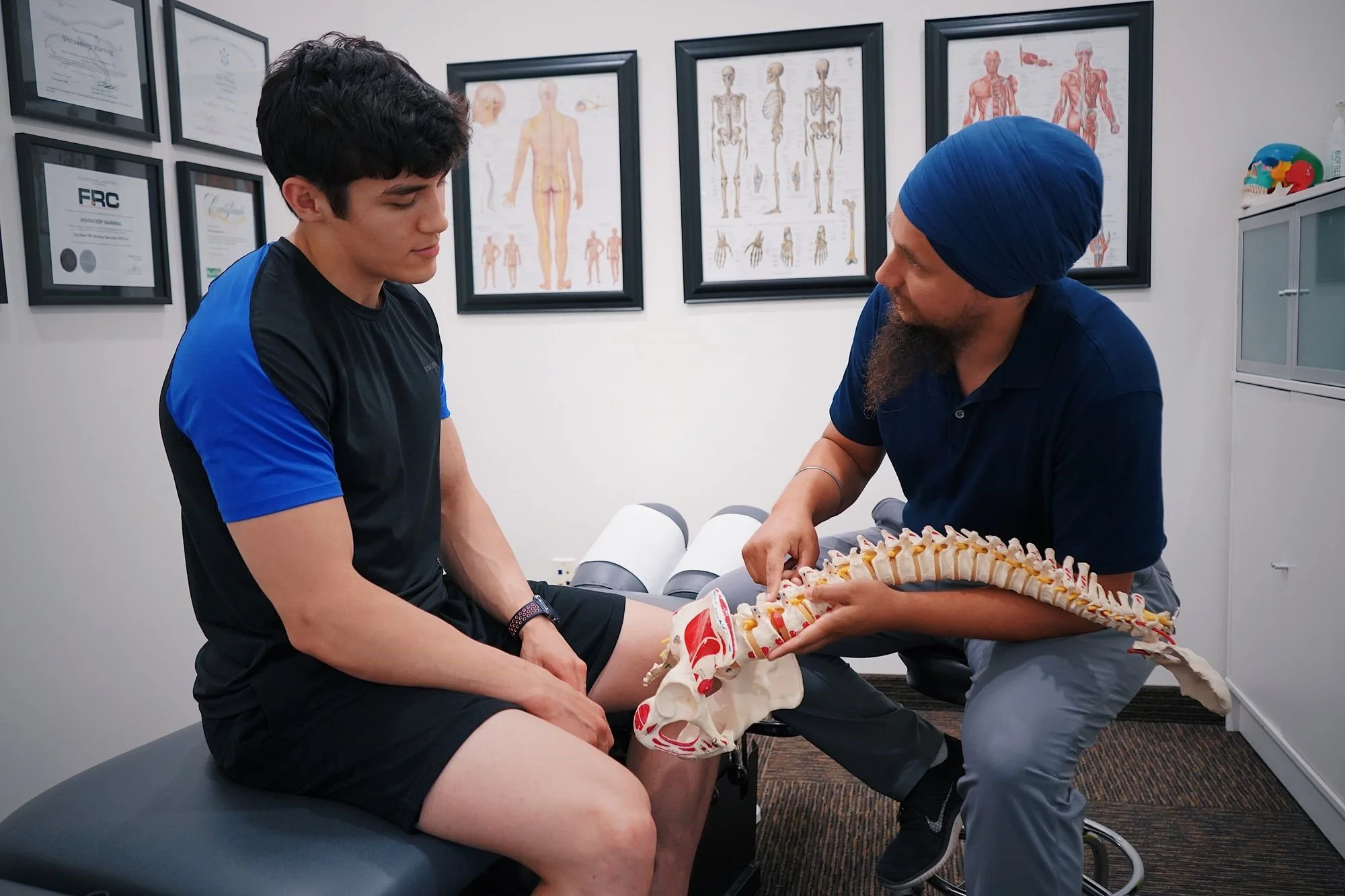

Illustrative stock photograph of a male practitioner explaining spinal anatomy during a consultation. The people shown are not associated with the Irvine study or the Body Mind Empowerment Centre.
Image credit: World Sikh Organization of Canada/Pexels. Used under the Pexels licence. Source: Pexels source page
Ways to evaluate and understand health
One of the interesting aspects of the Irvine research was its broader approach to evaluating health. A related Network Care research summary describes two broad ways of looking at health: a biomedical approach, which tends to focus on disease, symptoms and measurable clinical findings, and a holistic or wellness approach, which also considers function, personal perceptions and overall quality of life.³
The Irvine researchers make a similar point in the way they justify their own methods: they note that simply asking people to rate their own health in general isn't just a helpful predictor of things like long-term survival - it's also a useful way of assessing health more broadly, rather than only checking whether disease or symptoms are present.¹ As I mentioned earlier, a state of health is far more than simply the absence of disease - it is a state of being from which we can truly enjoy life. The Irvine researchers appear to have embraced a similarly broad view, incorporating this perspective into their survey by considering respondents' perceptions of physical, mental and social wellbeing, function and overall quality of life, rather than looking only at symptoms or disease-related measures.¹ Halbert Dunn, a physician and biostatistician often credited as the father of the modern wellness movement, described health in similarly broad terms back in the 1960s - as a person's capacity to function at their fullest potential within the environment around them, not merely the absence of illness.⁴ The yoga teacher B.K.S. Iyengar, who helped bring yoga to much of the Western world, put it even more simply: “Health is a state of complete harmony of the body, mind and spirit.”⁵
My wish for you is to move better, feel better, and live better,
Dr Jason W. Barritt B.Sc (Hons) DC
Chiropractor at the Body Mind Empowerment Centre, Lyneham, Canberra
These findings show associations, not guarantees - everyone responds differently. This article is for general health education, not personal medical advice. If you have specific health concerns, it's best to speak with a registered healthcare professional in person.
If you'd like to go deeper into the science behind NSA care - including how it may support the nervous system's ability to adapt, and where it sits within safe, evidence-informed practice - keep an eye out for Part B of this series, coming soon.
I look forward to meeting you soon. Book your initial consultation here...
References:
1. Blanks RHI, Schuster TL, Dobson M. A Retrospective Assessment of Network Care Using a Survey of Self-Rated Health, Wellness and Quality of Life. Journal of Vertebral Subluxation Research. 1997;1(4).
2. Dubos RJ. Mirage of Health: Utopias, Progress, and Biological Change. New Brunswick (NJ): Rutgers University Press; 1987. p. 26. Reprint of the 1959 edition.
3. Association for Network Care. A Retrospective Assessment of Network Care [research brochure, Internet]. [Date unknown] [cited 2026 Aug 21]. Available from: https://gatewaysintohealth.com/wp-content/uploads/2009/04/anc_research_brochure.pdf
4. Dunn HL. High-Level Wellness. Arlington, VA: R. W. Beatty; 1961.
5. Iyengar BKS. Light on Life: The Yoga Journey to Wholeness, Inner Peace, and Ultimate Freedom. Emmaus (PA): Rodale; 2005. p. 48.